
DOT Reflective Tape Requirements For Trucks Explained
Real Client Testimonials
Tonya's
Story
Recover Out-of-Pocket Vehicle Repair Costs Up to $3,000 for Free.
Find Out How ›
Text Us Call Us

DOT Reflective Tape Requirements For Trucks Explained
Have You Been Injured?

Get free legal advice today

What Are The FMCSA DOT Reflective Tape Requirements For Trucks?

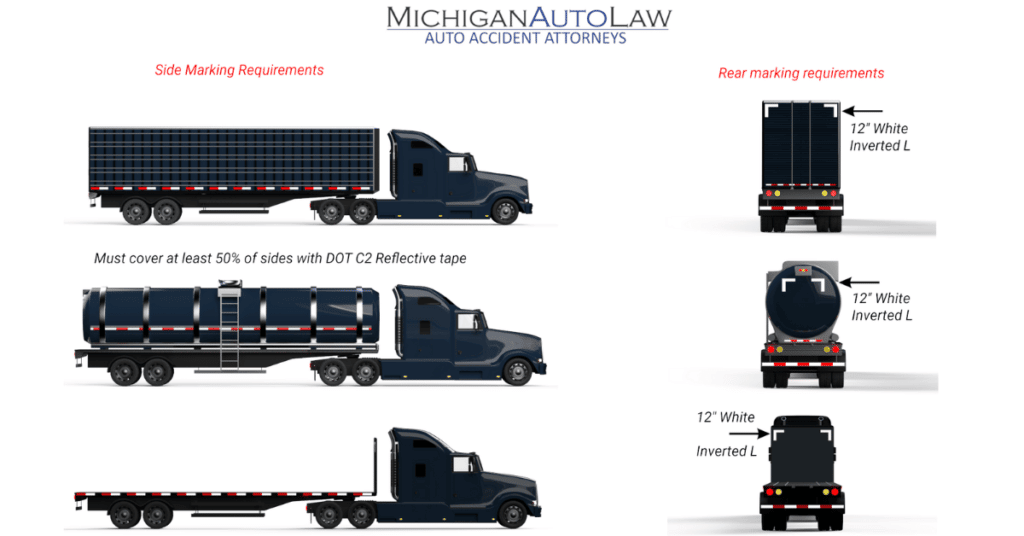
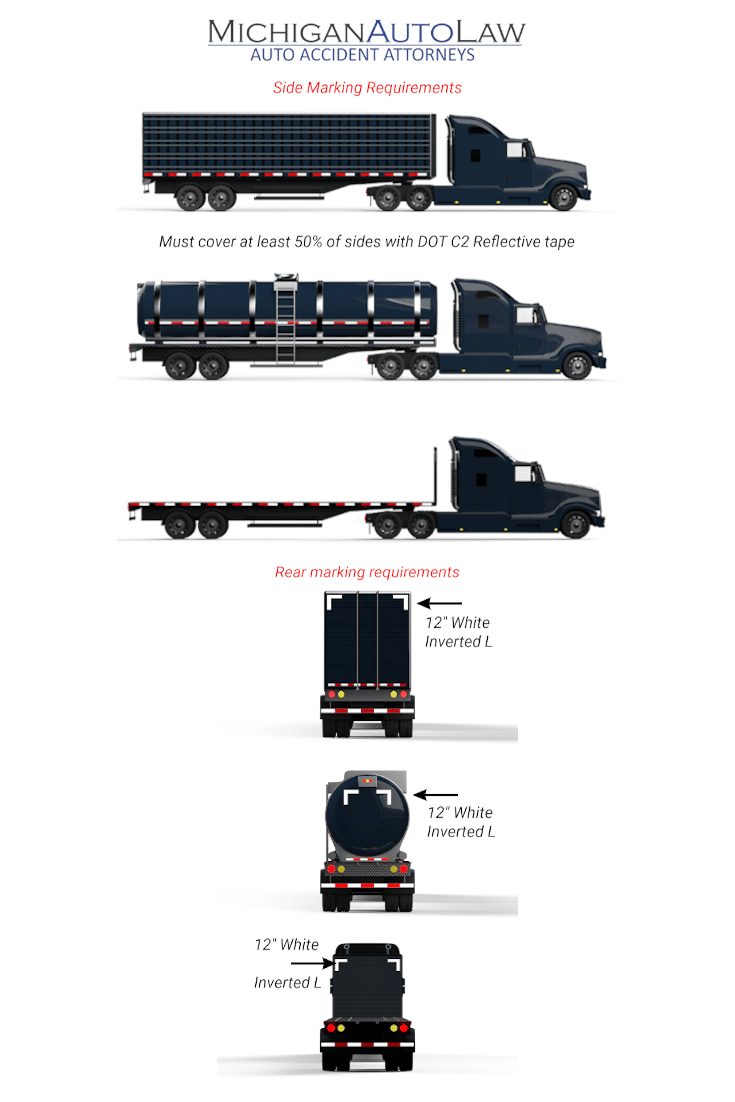
Under 49 CFR § 393.11, the reflective tape requirements for trucks specify that commercial trailers over 80 inches wide and 10,000+ lbs GVWR must use DOT-C2 certified conspicuity markings in these locations:

  • DOT-C2 tape, minimum 2 inches wide, stamped every 12 inches
  • Alternating red and white tape covering at least 50% of each side’s length
  • Tape positioned 15 to 60 inches above the road surface
  • Continuous red/white tape across the entire lower rear crossmember
  • Two inverted “L” white or silver strips, at least 12 inches long, on the upper rear corners
  • Two 24-inch red/white strips on semi tractor rear fenders or mudflap brackets
Requirement Feature Specification / Standard
Approved Tape Material DOT-C2 certified (stamped on the tape every 12 inches)
Tape Width Minimum 2 inches wide
Color Scheme Alternating red and white (sides/lower rear); Solid white/silver (upper corners)
Side Coverage Rule ≥ 50% of trailer length in an evenly spaced or continuous line
Height Placement Between 15 inches and 60 inches from the ground
Exemptions Pole trailers and trailers designed exclusively for living/office use

Why Do The DOT Reflective Tape Requirements For Trucks Exist?

NHTSA research found that trucks meeting DOT reflective tape requirements through conspicuity tape reduces side and rear crashes in low-visibility conditions by 29% and cuts related injuries and fatalities by 44%. If every commercial motor vehicle in the U.S. complied, the study estimates up to 7,800 crashes, 5,000 injuries, and 350 deaths could be prevented each year.

According to the DOT  requirements, all commercial trucks are legally required to be equipped with highly reflective tape or its equivalent in the form of reflectors, to help other drivers identify the tractor trailer, especially in low-visibility conditions, reducing the risk of accidents. But drive down any Michigan highway and it’s shocking to see just how many tractor trailers still do not use this product.

A National Highway Traffic Safety Administration  study behind these figures also found that conspicuity markings are especially effective at preventing nighttime side and rear collisions with heavy tractor-trailers — the exact scenario where a truck without reflective tape becomes nearly invisible to an approaching driver.

Regardless, many commercial drivers and transportation companies throughout the country and in Michigan neglect to adhere to the DOT reflective tape requirements for their trucks. Since the absence of these conspicuity markings on tractor trailers has been proven to cause catastrophic accidents, there is very little excuse for why fleets haven’t adhered to the laws for older tractor trailers that are still in service as this product is inexpensive.

Also, if a commercial driver is caught driving a newer model tractor trailer without these conspicuity markings, he or she can be cited with a safety violation and the vehicle can be taken out of service (shut down).

Proper Installation Is Key

Proper installation of DOT reflective tape on trucks is essential to ensure visibility and compliance with federal safety requirements and regulations. These conspicuity markings should be applied to clean, dry surfaces free of dirt, grease, or rust to ensure strong adhesion. For tractor trailers, conspicuity markings must be placed in specific locations as outlined by the Federal Motor Carrier Safety Administration (FMCSA), including along the sides and rear of the vehicle. Apply the conspicuity markings in straight, continuous lines, using a measuring tool or level to ensure proper alignment. Press firmly to secure the adhesive and avoid wrinkles or air bubbles. It’s also important to use the correct color and pattern—typically alternating red and white segments—for regulated commercial vehicles. Always follow the manufacturer’s instructions for best results and long-lasting performance.

How Often Should These Conspicuity Markings Be Replaced?

There’s no set requirement for replacing DOT reflective tape on trucks, but it must always be in good condition. If the conspicuity markings becomes faded, damaged, peeling, or loses its reflectivity, it must be replaced right away to stay compliant with FMCSA regulations. Conspicuity markings on tractor trailers should be checked regularly—ideally during pre-trip inspections or routine maintenance—to ensure it remains clean, intact, and clearly visible. Staying proactive helps you avoid violations and keeps your vehicle safe for the road.

What Happens If A Truck Violates The DOT Reflective Tape Requirements?

Trucks that violate the DOT reflective tape requirements can result in severe federal civil penalties, out-of-service orders, and a legal presumption of negligence if the vehicle causes an accident. Under Federal Motor Carrier Safety Administration (FMCSA) safety regulations governed by 49 C.F.R. § 393.11, commercial carriers can face regulatory fines ranging roughly from $1,000 to $16,000+ per violation. These fines scale upward based on the carrier’s history of noncompliance and whether the defects reveal a systemic failure to maintain basic safety equipment.

From an enforcement standpoint, tractor trailers caught during roadside inspections with missing, peeling, or improperly placed conspicuity tape will be cited and can be placed Out-of-Service (OOS). This legally bans the vehicle from operating on public roads until the safety hazard is completely repaired.

In a civil truck accident lawsuit, a violation of the DOT reflective tape requirements (49 C.F.R. § 393.11) serves as powerful evidence of negligence. Because these federal conspicuity marking rules are explicitly designed to prevent catastrophic, low-visibility side-impact and underride collisions, showing that a carrier failed to meet these standards shifts the legal burden, making it incredibly difficult for the defense to blame a passenger vehicle driver for a nighttime crash.

Does The Tape Need To Be Continuous?

No, DOT reflective tape requirements do not mandate one continuous strip on a commercial truck trailer, but the conspicuity markings must cover at least 50% of each side.

Federal conspicuity regulations under 49 C.F.R. § 393.11 establishes a strict “50% coverage rule” rather than mandating an uninterrupted line of tape. Under FMCSA safety requirements, alternating red-and-white DOT-C2 certified reflective tape must be applied as horizontally as practicable along both sides of the truck trailer, beginning and ending as close to the front and rear edges as possible.

Because a continuous run is not legally required, tractor trailer fleets are permitted to install the tape in multiple broken segments to avoid rivets, hinges, or brackets. However, the sum of all retroreflective tape segments must equal or exceed half the total length of the trailer box, and the un-taped gaps must be distributed as evenly as practicable. The gaps cannot be excessively long or grouped together in a way that breaks the recognizable visual outline of the tractor trailer at night.

In low-visibility tractor trailer crash litigation, evaluating the exact spacing layout is vital. If a motor carrier leaves aggressive, non-compliant gaps or allows significant sections of the tape to peel away, the resulting visual gap can leave a dark trailer effectively invisible to an approaching motorist. In a nighttime side-impact or rear-end collision, proving a violation of this 50% spacing regulation serves as devastating evidence of negligence against the transportation company.

Does Dirty, Faded, or Peeling Reflective Tape Count as a Violation of DOT Requirements For Trucks?

Yes, under DOT reflective tape requirements for trucks, dirty, faded, or peeling markings that fail to provide the legally required retroreflective visibility constitutes a direct federal violation. If road grime, peeling, or severe fading reduces the tape’s retroreflective performance, the carrier is in direct violation of safety rules. In a tractor trailer crash lawsuit, proving that poorly maintained tape reduced a trailer’s visibility from the legally required 1,000 feet down to under 100 feet is a critical piece of evidence used to establish carrier liability.

Carriers are responsible for routine maintenance of these conspicuity markings, not just initial installation. Daily pre-trip inspections and scheduled fleet checks should catch deterioration before a commercial vehicle is dispatched onto the road. When a motor carrier ignores visible signs of wear, such as cracked adhesive, dulled retroreflectivity, or sections that have fallen off entirely, courts and investigators often treat that neglect as evidence of a broader pattern of disregard for safety regulations across the entire fleet, which can strengthen a victim’s case well beyond the single equipment violation itself.

Which Commercial Trucks Have To Follow The DOT Reflective Tape Requirements?

Under federal safety requirements, DOT reflective tape (conspicuity tape) is mandatory for trailers and semi truck trailers that are 80 inches or more in overall width with a Gross Vehicle Weight Rating (GVWR) exceeding 10,000 pounds. This requirement is established under Federal Motor Vehicle Safety Standard (FMVSS) No. 108 (49 CFR 571.108) and enforced for commercial vehicles in service under 49 CFR 393.11.

Qualifying trailers must have alternating red and white retroreflective sheeting covering at least 50% of each side’s length, a full-width strip across the rear lower area, and white reflective strips at the upper rear corners. The semi is also required to carry retroreflective sheeting or reflex reflectors on the cab in accordance with FMVSS No. 108 S8.2 — ensuring the tractor itself remains visible regardless of whether it is coupled to a trailer.

How Does Missing DOT Reflective Tape Violate Federal Requirements And Prove Liability In A Nighttime Truck Crash?

Under federal safety requirements, DOT reflective tape is mandatory for trailers and semi truck trailers that are 80 inches or more in overall width with a Gross Vehicle Weight Rating (GVWR) exceeding 10,000 pounds, under 49 CFR 393.11, which incorporates the conspicuity system standards set by Federal Motor Vehicle Safety Standard (FMVSS) No. 108 (49 CFR 571.108). The purpose of these requirements is to reduce the risk of nighttime crashes by helping motorists recognize the presence, size, and movement of large commercial vehicles from a distance.

In a nighttime tractor trailer crash lawsuit, missing conspicuity markings can be powerful evidence of liability because it may show that the transportation company or driver failed to comply with federal safety standards. If investigators determine that the absence of conspicuity markings made the trailer difficult to see and contributed to the crash, the violation can help establish negligence and support a claim that the semi driver, motor carrier, or vehicle owner was responsible for the collision. In addition to FMCSA penalties and potential Out-of-Service consequences, evidence of missing conspicuity markings can strengthen a victim’s case for compensation by demonstrating that a preventable safety violation played a role in causing the crash.

Where Can Commercial Carriers Purchase The Approved Conspicuity Markings?

These conspicuity markings are available for purchase both online and in stores. Online retailers like Amazon, Walmart, and eBay offer a wide selection of certified options. You can also find it at Home Depot, Lowe’s, and industrial suppliers like Grainger. Automotive stores such as AutoZone, O’Reilly Auto Parts, and NAPA, as well as specialty retailers like Harbor Freight, Tractor Supply Co., and Northern Tool, carry commercial-grade conspicuity markings. For urgent needs, a quick search on Google can help you find local hardware or automotive stores.

When purchasing these markings, fleet managers should verify that the packaging displays the proper certification stamp and confirm the product meets the correct width and color specifications before installation. Buying from a reputable supplier matters since uncertified or counterfeit conspicuity markings may look similar but fail to provide adequate retroreflective performance in low-visibility conditions, leaving a commercial vehicle technically equipped yet still out of compliance with federal safety standards.

Were You Injured In A Truck Accident Where The DOT Reflective Tape Requirements Were Violated? Call Our Attorneys Now For A Free Consultation!

If you were injured in a tractor trailer crash in which the commercial driver or transportation company didn’t follow the DOT reflective tape requirements, call now (800) 968-1001 for a free consultation with an experienced truck accident lawyer. There is no cost or obligation. You can also visit our contact page or use the chat feature on our website.

Michigan Auto Law is Michigan’s largest and most successful law firm that specializes exclusively in helping people who have been injured in auto accidents.

Our secret? Our attorneys deliberately handle fewer cases than other personal injury law firms.  This allows us to focus more time and attention on our cases.

Unlike other law firms, our attorneys are never too busy to promptly return phone calls and answer questions. 

We have more than 3,500 5-Star Reviews that demonstrate this care and attention to detail.

More importantly, this client-focused approach leads to better and faster settlements for our clients. Michigan Auto Law has recovered more million-dollar settlements and trial verdicts for motor vehicle accidents than any other lawyer or law firm in Michigan. We’ve also recovered the highest ever reported car accident and tractor trailer accident settlement in the state.

Call now so we can start making a real difference for you.
Legally Reviewed By

Written By

Steve M. Gursten,
Attorney, License#: P53632

Nationally recognized trial attorney Steven Gursten has recovered the largest ever car accident settlement of any Michigan lawyer or law firm. For 14 straight years, he has been voted by Super Lawyers among the top 50 lawyers in the entire state of Michigan, out of over 65,000 Michigan lawyers. Steve was named a Michigan “Go To Lawyer” for Negligence Law by Michigan Lawyers Weekly.

Steve serves in leadership roles for the American Association for Justice Trucking Litigation Group and the AAJ Distracted Driving Litigation Group. For more than 30 years, Steve has devoted his practice exclusively to helping people injured in car, truck, and motorcycle accidents.

View attorney Steven Gursten's Full bio.

Legally Reviewed by Todd Berg, Attorney

Steve M. Gursten, Attorney

This article is for informational purposes only and does not constitute legal advice. See our Community Guidelines.

Last updated:

How Much Is Your Michigan Auto Accident Case Worth?

Michigan Auto Law is the leading and largest law firm in Michigan exclusively handling auto accident cases for more than 50 years. By answering a few simple questions we can help you determine how much your accident case could be worth

Find Out Now