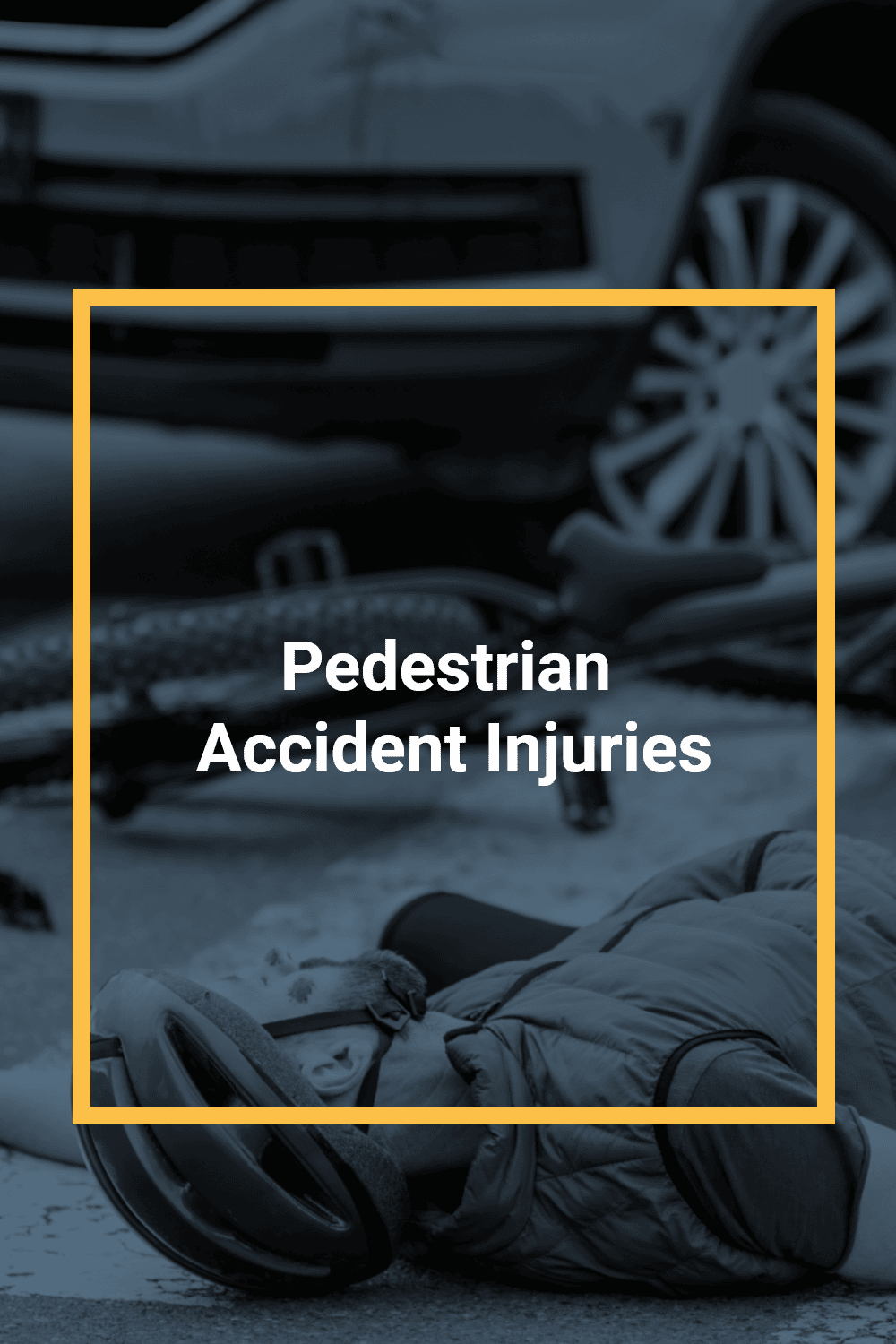
Michigan Pedestrian Accident Injuries: Most Common Explained
Real Client Testimonials
Tonya's
Story
Text Us Call Us

Michigan Pedestrian Accident Injuries: Most Common Explained

Have You Been Injured?

Get free legal advice today

Pedestrian injuries in traffic accidents can range from minor to life-threatening, often involving soft tissue damage, fractures, head and spinal trauma, and cuts or bruises. Older adults face an even greater risk of severe or fatal injuries due to increased physical vulnerability and slower recovery times.

Common types of pedestrian accident injuries

Common injuries sustained in pedestrian accidents include:

  • Head Injuries: Concussions, traumatic brain injuries (TBI), skull fractures, or other brain trauma, which can have serious long-term effects.
  • Broken Bones: Fractures in the arms, legs, ribs, pelvis, or other bones due to the impact of a vehicle.
  • Spinal Cord Injuries: Damage to the spine that can cause partial or complete paralysis, loss of sensation, or chronic pain.
  • Soft Tissue Injuries: Sprains, strains, bruises, and muscle or ligament damage.
  • Internal Injuries: Damage to organs such as the lungs, liver, spleen, or kidneys, which can be life-threatening if not treated promptly.
  • Cuts and Lacerations: Deep wounds or abrasions caused by impact or contact with broken glass and debris.
  • Psychological Trauma: Emotional distress, anxiety, or post-traumatic stress disorder (PTSD) resulting from the accident.

Factors affecting the severity of injury

Vehicle speed

In a pedestrian accident, vehicle speed plays a major role in the severity of injuries sustained. Higher speeds greatly increase the force of impact and shorten the driver’s reaction time, making it harder to prevent a collision. Even modest increases in speed can dramatically raise the risk of serious or life-threatening harm, as the human body is especially vulnerable to high-impact forces. At slower speeds, pedestrians have a better chance of surviving with less severe injuries, but as speed rises, the likelihood of catastrophic outcomes climbs sharply—underscoring the importance of speed control in reducing the consequences of these accidents.

Angle of impact

Pedestrian accident injuries can vary greatly depending on the angle of impact when a vehicle strikes the individual. A head-on impact often results in the most severe trauma, as the force is concentrated directly on the body and may throw the person forward or onto the vehicle’s hood and windshield. Side impacts can cause multiple points of injury, such as fractures to the legs, hips, and torso, due to the rotational motion of the body upon contact. Glancing or deflecting blows may result in less direct force, but they can still cause significant harm if the crash victim is knocked into another object or the ground. Understanding how impact angle influences injury severity highlights the importance of driver awareness and collision avoidance measures.

Age

Pedestrian accident injuries can be influenced significantly by the age of the person involved. Children often face a higher risk of head injuries because of their shorter stature and tendency to be struck in the upper body or head area, while older adults are more susceptible to severe outcomes due to reduced bone density, slower reflexes, and underlying health conditions. Age can also affect recovery time, with younger individuals typically healing faster and older victims facing longer rehabilitation periods or complications. These differences make it essential to consider age-related vulnerabilities when assessing the severity and long-term impact of these types of crashes.

Impact location

Pedestrian accident injuries can be greatly affected by the impact location when a vehicle strikes a person. If the initial contact is to the lower body, such as the legs or hips, the force can cause fractures and may throw the crash victim into the path of secondary impacts, like hitting the hood or roadway. Strikes to the upper body or head tend to be more severe, often resulting in traumatic brain injuries, internal organ damage, or fatal outcomes due to the vulnerability of these areas. Even side versus frontal impacts can lead to different injury patterns, with side impacts often causing rotational forces that increase the risk of multiple injuries. Understanding how impact location influences injury severity is crucial for improving vehicle design and safety measures.

Alcohol involvement plays a significant role in causing pedestrian accidents and injuries

Alcohol involvement from either pedestrians or drivers plays a significant role in the occurrence and severity of accident injuries. Impaired drivers have reduced reaction times, poor judgment, and diminished coordination, increasing the likelihood of striking someone and causing severe harm. Likewise, alcohol-impaired walkers may misjudge traffic speeds, fail to use crosswalks, or engage in unsafe road crossings, putting themselves at greater risk. In both cases, alcohol can contribute to higher-impact collisions, delayed emergency responses, and resulting in more severe consequences, making impairment a critical factor in many collisions with people.

Can I sue for my pedestrian accident injuries in Michigan?

In Michigan, if you’re injured in a pedestrian accident you can sue the at-fault driver for pain and suffering if your injury causes a serious impairment that affects your daily life. Lawsuits typically must be filed within three years. In hit-and-run cases, you can still claim benefits through your own insurance and may recover compensation if you have uninsured motorist coverage.

You can also receive Personal Injury Protection (PIP) benefits regardless of fault. These No-Fault benefits cover medical expenses, lost wages, and care services, even if you don’t own a vehicle, but you must file a claim within one year.

Proving driver negligence is key, but our state’s comparative fault rules allow you to recover damages even if you share some blame, though compensation may be reduced. It’s important to seek medical care, report the crash, and consult a skilled Michigan pedestrian accident attorney to protect your rights and maximize compensation for your injuries.

What types of damages can I recover for my pedestrian accident injuries in Michigan?

In Michigan, if you’re injured in a pedestrian accident, you may be able to recover several types of damages for your injuries:

  1. Medical Expenses: This includes current and future costs for hospital stays, doctor visits, surgeries, medications, physical therapy, and other treatments related to your injury.
  2. Lost Wages: Compensation for income lost while you’re unable to work due to your injuries, as well as potential loss of future earning capacity if your injury affects your ability to work long-term.
  3. Pain and Suffering: Damages for physical pain, emotional distress, mental anguish, and loss of enjoyment of life caused by the accident and your injuries.
  4. Disability or Disfigurement: Compensation if your injury results in permanent disability or noticeable disfigurement.
  5. Property Damage: If any of your personal property (like a wheelchair, clothing, or devices) was damaged in the accident.
  6. Other Economic Losses: Such as costs for household help, transportation to medical appointments, or other crash-related expenses.

Pain and suffering compensation

In Michigan, you may be able to sue the at-fault, negligent driver who caused your pedestrian accident injuries for compensation for pain and suffering damages, excess medical bills, excess lost wages and other economic damages. 

In order to successfully recover pain and suffering compensation, state law requires that you show that you have suffered a “serious impairment of body function,” which is the legal threshold under state’s No-Fault law for injured victims seeking to recover “noneconomic loss” damages.

Excess medical bills and excess lost wages are some of the economic damages you can recover from the at-fault driver. These damages will help to pay for your medical bills and to reimburse you for lost income that is not covered by the limits of the auto insurance policy through which you are claiming benefits and/or what is guaranteed to injured victims under the No-Fault law.

About your compensation

Compensation for your injuries may likely include compensation for your pain and suffering, excess medical expenses, excess lost wages and other economic damages. The amount you will be compensated will depend considerably on the limits of the at-fault driver’s liability coverage.

Under Michigan law, all drivers must carry a minimum of $250,000/$500,000 in liability insurance coverage also known as third party car insurance. However, the law also gives them the option “to purchase lower limits” of $50,000 and $100,000. (MCL 500.3101(1); 500.3131(2); 500.3009(1)(a) and (b), (5))  

In Michigan, if the at-fault driver who caused your pedestrian accident injuries was driving for Uber or Lyft or was operating a truck or commercial vehicle or was an employee of a business and acting within the scope of his or her employment at the time that he or she injured you, then the liability insurance coverage limits that apply to your crash may be higher. 

The compensation for your injuries can also be affected by the amount of umbrella insurance coverage the at-fault driver has as well as his or her personal assets that could be used to contribute to the compensation that he or she is liable to you for.

Michigan No-Fault benefits for pedestrian accident injuries

You may be entitled to recover No-Fault PIP benefits for your pedestrian accident injuries that will help to pay for medical expenses, lost wages (if your injuries prevent you from returning to work), mileage and transportation costs for traveling to and from your doctor appointments, household replacement services and attendant care services.

Within one (1) year after the accident that caused your injuries, you file an application for No-Fault benefits – which is also called a “written notice of injury” – with the responsible auto insurance company. (MCL 500.3145(1) and (4)) 

The responsible auto insurance company will be one of the following: (1) your own auto insurance company; (2) the insurer for your spouse or a relative who lives with you; or (3) the auto insurance company assigned by the Michigan Assigned Claims Plan (when No-Fault coverage is not available through any other source).

Filing the application for No-Fault benefits – and filing it on time – is extremely important because the failure to do so will give the insurance company a legal basis to deny all No-Fault benefits that you would have otherwise been entitled to.

How long does a settlement take?

The time it takes to resolve a settlement can vary widely depending on several factors. On average, settlements may take anywhere from a few months to over a year. Here’s what influences the timeline:

  • Severity of Injuries: More serious injuries often require longer treatment and recovery, which means the full extent of damages isn’t clear right away. This can delay settlement until your medical condition stabilizes.
  • Insurance Company Response: How quickly the insurance company investigates, evaluates, and negotiates can speed up or slow down the process.
  • Liability Disputes: If there’s disagreement over who’s at fault, it can take longer to resolve.
  • Complexity of the Case: Cases involving multiple parties, uninsured drivers, or complex damages often require more time.
  • Legal Process: If negotiations fail, the case may proceed to litigation, which can add months or years.

In Michigan, many pedestrian accident injury claims settle within 6 to 12 months, but some cases resolve faster, while others may take longer. Consulting with an experienced attorney can help you understand the likely timeline for your specific case and work toward a timely resolution.

Prevention

Both pedestrians and drivers play vital roles in preventing pedestrian accidents and reducing injuries. People walking can enhance their safety by staying alert, using designated crosswalks, obeying traffic signals, and avoiding distractions like phones while walking near roads. Wearing visible clothing, especially at night, also helps drivers see them more clearly. Drivers, on the other hand, should always stay attentive, obey speed limits, and be especially cautious in areas with heavy foot traffic such as school zones and residential neighborhoods. Avoiding distractions, never driving under the influence, and yielding the right of way to those on foot are crucial steps drivers can take to prevent collisions. When both parties follow these safety practices, the risk of accidents and serious injuries can be significantly reduced.

If you have questions about a lawsuit for your injuries after a pedestrian car accident in Michigan, call now (800) 968-1001 for a free consultation with an experienced lawyer. There is no cost or obligation. You can also visit our contact page or use the chat feature on our website.

Michigan Auto Law is Michigan’s largest and most successful law firm that specializes exclusively in helping people who have been injured in auto accidents.

Our secret? Our attorneys deliberately handle fewer cases than other personal injury law firms.  This allows us to focus more time and attention on our cases.

Unlike other law firms, our attorneys are never too busy to promptly return phone calls and answer questions. 

We have more than 3,000 5-Star reviews that reflect this care and attention to detail.

More importantly, this client-focused approach leads to better and faster settlements for our clients. Michigan Auto Law has recovered more million-dollar settlements and trial verdicts for motor vehicle accidents than any other lawyer or law firm in Michigan. We’ve also recovered the highest ever reported truck accident and car accident settlement in the state.

Call now so we can start making a real difference for you.

Last updated:

How Much Is Your Michigan Auto Accident Case Worth?

Michigan Auto Law is the leading and largest law firm in Michigan exclusively handling auto accident cases for more than 50 years. By answering a few simple questions we can help you determine how much your accident case could be worth

Find Out Now

CLICK FOR LIVE CHAT