
Michigan Rollover Car Accident Guide: Causes, Survival Steps And Legal Rights
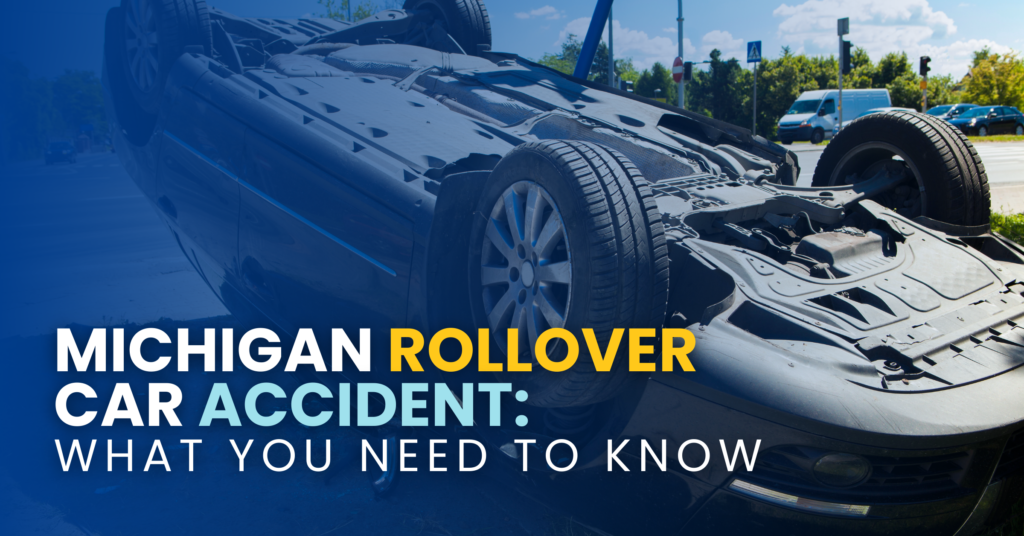
A rollover car accident is a severe type of crash where a vehicle tips over onto its side or roof. These high-impact collisions often result in catastrophic injuries or fatalities, accounting for nearly one-third of all traffic deaths nationwide. If you or a loved one were hurt in a rollover crash in Michigan, an experienced car accident lawyer can help you and your family win the pain and suffering compensation and money damages you are legally entitled to.
Nearly one third of all the people who lose their lives in traffic crashes in a year’s time did so in a rollover car accident.
Speeding is a common cause of an overturning crash, but there are several other causes such as distracted or reckless driving and operating a vehicle under the influence of alcohol or drugs. Additionally, vehicles with a high center of gravity, too much tire grip, and excess cargo are also at risk for a vehicle flip
What is a Rollover Car Accident?
A rollover accident is a car accident where a vehicle tips over onto its side or rolls completely over. In some of these crashes, a motor vehicle or commercial vehicle may roll over several times before it comes to a complete stop.
Most rollover car accidents occur when a vehicle hits another object that shifts the vehicle’s weight to one side, causing it to roll before it can regain its balance. However, an overturning crash can happen without impact because of factors such as speeding. If you speed around a curve or take a turn too fast, the tires can lose their grip on the road, leading to a vehicle flip.
There are two primary types of rollover car accidents:
- Tripped Rollover Car Accident: This type of overturning crash occurs when a vehicle comes into contact with an external object (such as a curb, ditch, guardrail, or soft ground) that causes the tires to catch and trip the vehicle into a tumble. Tripped vehicle flips account for the vast majority of single-vehicle overturns.
- Untripped Rollover Car Accident: This type of untripped overturning crash happens during high-speed, sharp maneuvers where steering, speed, and ground friction overcome gravity without hitting an outside object. Top-heavy vehicles are at a higher risk for untripped vehicle flips. Untripped rollovers are less common, but equally dangerous.
Rollover Car Accident Statistics
Rollover traffic crashes accounted for 28% of all passenger vehicle occupant deaths in the U.S. in 2024. (NHTSA, Traffic Safety Facts, 2024 Data, Passenger Vehicles)
In the U.S. in 2024, there was a total of 205,794 rollover crashes. 7,466 were fatal crashes. 120,106 were injury accidents. And 78,222 were collisions involving only property damage. (NHTSA, Traffic Safety Facts Annual Report, 2024, Table 38) 6,250 people were killed in rollover crashes involving passenger cars and light trucks in the U.S. in 2024. (NHTSA, Traffic Safety Facts Annual Report, 2024, Tables 23 and 90)
The vehicles with the highest percentage of overturning crash deaths in 2024, according to NHTSA, were:
- Pickups: 39%
- SUVs: 32%
- Vans: 23%
- Passenger cars: 20%
Critical Safety And Prevention Measures
To reduce the risk of an overturning crash or increase survival odds during a collision, safety experts emphasize the following measures:
- Wear Your Seatbelt: This is the single most effective way to survive an overturning crash. The vast majority of vehicle flip fatalities involve occupants who were completely unbelted and ejected from the vehicle.
- Electronic Stability Control (ESC): Standard on modern vehicles, ESC automatically applies brakes to individual wheels when it detects a potential loss of steering control, drastically lowering overturning risk.
- Tire Maintenance: Properly inflated tires with good tread depth prevent sudden blowouts and loss of traction during sharp maneuvers.
- Avoid Overloading: Overloading a vehicle, especially placing heavy cargo on a roof rack, raises its center of gravity and increases instability.
Odds of Surviving a Rollover Car Accident
Your odds of surviving a rollover car accident are likely around 96%, given that approximately 3.6% of overturn crashes in the U.S. in 2024 were fatal, according to NHTSA, Traffic Safety Facts Annual Report, 2024, Table 38.
NHTSA also reports that in the U.S. in 2024 the passenger vehicle occupant fatality rate was 2.21 per 100,000 registered vehicles for vehicles that are involved in overturning crashes.
Your odds of surviving an overturning crash can be significantly increased depending on how you react during the crash. Taking the following steps will greatly increase your chance of survival and lessen the odds of catastrophic injuries:
- Ready yourself for the overturning: If your vehicle begins to tip and you suspect it is about to roll over, immediately remove your feet from the pedals to prevent ankle breakage. Release the steering wheel, crossing your arms against your chest as you press your body deep into the seat. Make sure not to lean forward when the car rolls, as this can increase the occurrence of arm breaks and traumatic brain injury.
- Check for injuries and remain calm: When the car has come to a stop, brace your feet against the floor to stabilize your body and assess the damage to yourself and your passengers. Everyone should run their hands across their head and hair checking for broken glass, blood, or severe injury that may not be immediately noticed in the event of a traumatic incident. If anyone is injured, do not move them. Call 911 immediately.
- Turn off the engine: If you landed upside down after a rollover car accident, turn off your engine immediately to mitigate explosion risks.
- Exit the vehicle safely: If you land upside-down and you appear to be uninjured, reach toward your ceiling, bracing yourself with one hand while stabilizing your feet on the floor of the vehicle, and then undo your seatbelt. Be extremely careful, as this is where the majority of post-crash injuries occur. Check your windows to determine the safest exit and crawl towards it. If the door does not open, you’ll need to either roll down or break a window, being careful to clear away any glass shards or debris before exiting. Once you’re free of the car, assist any passengers with their exit and then move as quickly as possible away from the vehicle in case of a fuel leak.
- Stay clear of traffic: Many drivers have survived vehicle flips only to be hit by oncoming traffic as they exit the vehicle. Stay off the road and on the shoulder, as far from traffic as possible.
Common Causes of Rollover Crashes
According to state and federal safety data, severe single-vehicle and multi-vehicle overturning crashes frequently occur on major municipal corridors, highway exits, and roadways across Michigan. The primary causes include:
- Speeding: Speeding is the most common cause of an overturning crash (accounting for approximately 40% of fatal vehicle flip incidents).
- Driving under the influence: Impairment drastically reduces reaction times and control during sharp turns.
- Distracted driving: Taking eyes off the road leads to sudden, violent corrections that trip a vehicle.
- Falling asleep at the wheel: Drowsy driving often causes unintended drift off the road, resulting in tripped vehicle flips via soft ground or ditches.
- Vehicles with a high center of gravity: Any vehicle can roll over, but SUVs, pickup trucks, vans, and commercial transport vehicles have a higher center of gravity and narrower track widths, making them significantly more susceptible to tipping than typical passenger cars.
- Seasonal Weather And Ice: Michigan winters bring black ice, slush, and heavy lake-effect snow. A vehicle sliding sideways and catching its tires on a snowbank, curb, or unpaved shoulder is a classic recipe for a “tripped” vehicle flip.
- Rural and Unlit Roads: While high-density traffic clusters around metro areas like Wayne, Oakland, and Macomb counties, Michigan’s rural counties face unique road hazards. Narrow country roads, soft unpaved shoulders, and a lack of street lighting make avoiding sudden obstacles or recovering after drifting off-road much harder.
- Wildlife Crossings: Swerving sharply to avoid deer, a very common hazard across Michigan highways and rural routes, frequently triggers driver over-correction, leading to loss of control and vehicle tipping.
- Tire Grip & Cargo Overloading: Too much tire grip or poor tread depth can cause sideways tripping forces during sharp turns, while overloading a vehicle shifts its center of gravity and increases instability.
- Mechanical failure: Faulty airbags, tire failure, poor suspension system design, defective brakes, and other mechanical issues can lead directly to an overturning crash. If a vehicle was defectively designed or manufactured, the manufacturer can be held legally responsible.
Rollover Car Accident Injuries
Rollover car accidents result in many of the same injuries as standard collisions, but the multi-directional impact forces create unique catastrophic trauma, including:
- Ejection injuries: Unrestrained occupants are at an extreme risk of being partially or completely ejected from the vehicle during an overturning crash, which drastically increases the likelihood of fatal or severe injuries.
- Impact injuries: Occupants sustain severe trauma from hitting interior surfaces, such as the roof, windows, steering column, or other passengers, as the vehicle tumbles. Head, neck, spinal cord, and limb fractures are common.
- Crush injuries: The vehicle’s roof structure can collapse or deform inward during an overturning crash, causing devastating crush injuries to occupants.
- Seat belt injuries: While crucial for preventing ejection, tight restraint forces during multiple-rotation overturning crashes can cause severe chest or abdominal trauma if not positioned correctly.
- Fatalities: Due to multiple impacts and ejection risks, overturning crashes have a disproportionately high fatality rate compared to standard side-impact or rear-end wrecks.
Michigan Rollover Car Accident Settlements And Legal Support
Under Michigan’s auto no-fault insurance system (MCL 500.3105), if you are injured in an overturning crash, your own Personal Injury Protection (PIP) insurance typically covers medical expenses and lost wages, regardless of who caused the crash. However, pursuing a third-party tort claim for pain and suffering against a negligent driver requires meeting the Michigan’s “serious impairment of body function” threshold under MCL 500.3135.
Our Michigan attorneys have the skill, experience, and specialized knowledge to fight to win rollover car accident settlements for our clients that reflect the full value of their cases. At Michigan Auto Law®, we specialize in motor vehicle crash cases, and we intentionally take fewer cases than other personal injury attorneys so we can focus intensely on our clients.
Our reputation for taking cases to trial and our track record of successful results allow our experienced motor vehicle crash attorneys to settle cases faster and for significantly more money than other law firms who do not have this proven record of success protecting automobile crash victims. In fact, our attorneys have won the largest auto and truck settlements of any Michigan lawyer or law firm. If you need help, contact us today for a free consultation.
Injured In A Rollover Car Accident In Michigan And Need A Lawyer? Call Our Attorneys Now For A Free Consultation!
If you or a loved one was injured in a rollover car accident in Michigan and you have concerns and questions about your legal rights to pain and suffering compensation, economic damages and auto No-Fault insurance benefits, call now (248) 970-1764 for a free consultation with one of our experienced attorneys. There is no cost or obligation. You can also visit our contact page or use the chat feature on our website.
Michigan Auto Law® is Michigan’s largest and most successful law firm that specializes exclusively in helping people who have been injured in automobile crashes.
Our secret? Our attorneys deliberately handle fewer cases than other personal injury law firms. This allows us to focus more time and attention on our cases.
Unlike other law firms, attorneys are never too busy to promptly return phone calls and answer questions.
We have more than 3,800 5-Star Reviews that reflect this care and attention to detail.
More importantly, this client-focused approach leads to better and faster settlements for our clients. Michigan Auto Law® has recovered more million-dollar settlements and trial verdicts for motor vehicle crashes than any other lawyer or law firm in Michigan. We’ve also recovered the highest ever reported truck crash and car crash settlement in the state.
Call now so we can start making a real difference for you.
Steve M. Gursten,
Michigan Auto Law® Attorney -
Steven Gursten is an attorney and President of Michigan Auto Law®, specializing exclusively in Michigan No-Fault insurance, car, truck, motorcycle, and bus accident litigation, including catastrophic personal injury and traumatic brain injury (TBI) claims. Steven has secured the largest reported auto and truck accident settlements and trial verdicts of any attorney in Michigan. He is a Past President of the American Association for Justice (AAJ) Trucking and Traumatic Brain Injury Litigation Groups and has been named a Top 50 Michigan Super Lawyer, a Michigan "Go To Lawyer for Negligence Law" by Michigan Lawyers Weekly, and a Top Lawyer in Metro Detroit by DBusiness Magazine. He was recognized as "Lawyer of the Year" by The Best Lawyers in America® and received the Courage Award from The Melvin M. Belli Society for his advocacy against CURE Auto Insurance Company in Michigan.
Read Steven Gursten’s full attorney profile
This article is for informational purposes only and does not constitute legal advice. See our Community Guidelines.